
From listing to doorstep, with the seller's warnings marked on the route
Each advance line on a listing matters at one particular step of the order, so it helps to know the route before you pay.
The route, step by step
Here is the whole order as most agents run it, from listing to doorstep, with the moment each seller warning comes into play. Agents differ in names for the steps and in the length of each window; these are the broad stages; details and branching decisions vary.
- Find the piece in the catalogue and open the listing itself.
- Read the shop notice and the last detail pictures; note every advance line.
- If the listing says ask first, have the agent's buyer ask before you pay.
- Paste the link at the agent, choose size and colour, add a short note.
- Pay. The agent's buyer places the purchase after accepting the request; follow the actual order status rather than assuming it is immediate.
- Wait for dispatch: days for ordinary pieces, the printed window for pre-sale.
- The piece reaches the warehouse and gets a basic check and a few photos.
- Compare the photos with the listing and your notes; ask for returns inside the window.
- Group accepted pieces into a parcel, pick a shipping line and pay for it.
- Customs in your country, then delivery and a short reporting clock.
Questions worth sending to the seller before checkout
Before paying is the best time to settle a detail that could change your choice, and the agent's buyer is the one who asks. Keep questions short, one fact each, and ask for numbers rather than opinions.
- Is this size in stock in this colour?
- What is the chest width, length or waist of this size, laid flat, in centimetres?
- Is the fabric see-through in the pale colour?
- When will it ship, counted from payment?
- Is this piece covered by the sale or no-return line?
Answers come back through the agent's order page or support chat. Save them: a written answer helps establish the agreed specification, but does not by itself guarantee a dispute outcome. And watch the agent's messages; iTaoBuy, for one, states that an out-of-stock order is cancelled if you do not reply within 72 hours.
The days between payment and the warehouse
After payment comes the quietest stretch of the order. The agent's buyer pays the seller, the seller packs and ships, and the parcel crosses China to the warehouse. iTaoBuy and JoyaGoo both write that domestic sellers generally ship within three to seven days, and both leave pre-sale goods out of that figure. Inside China the parcel then takes a few more days, depending on how far the shop is from the warehouse.
A shop notice can stretch this. A holiday pause holds dispatch until the shop reopens; fixed dispatch days add up to several days on their own. Neither is a breach, which is why reading the notice before paying saves a lot of anxious messages later.
The short window after the photos
Once a piece is checked in, the return window opens and it is short. Hipobuy and Oopbuy give 120 hours from the moment the item is recorded as stored. JoyaGoo counts five days from the status QC completed, iTaoBuy five days from received. LoongBuy says some eligible products support a five-day no-reason refund and that it does not apply to all goods. Basetao's page puts the window at seven days for most sellers, counted from the parcel's arrival at its warehouse.
All of them add the same condition in different words: the seller must agree. That is where the advance lines come back. A change-of-mind request and a claim about the wrong item or an undisclosed defect need different evidence. Ask the agent which procedure, deadline and costs apply; a printed label alone does not resolve the claim.
Two bills, with a decision between them
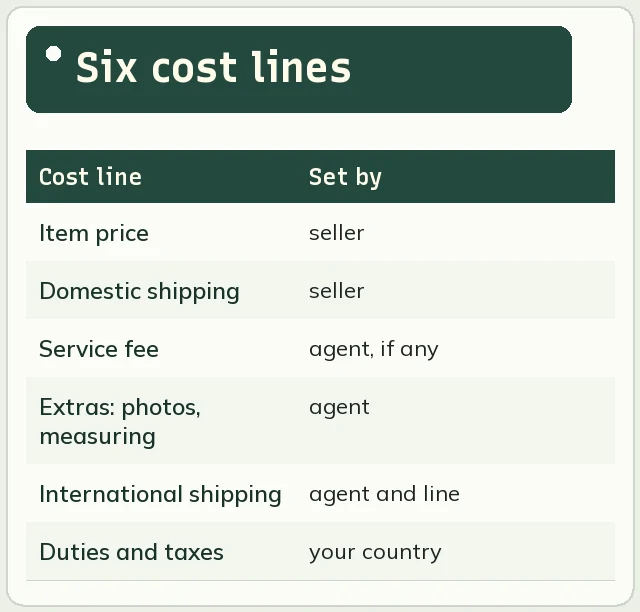
The seller’s item price is only one part of the total. Before the first payment, read the goods, domestic-delivery and service lines in the agent’s checkout and the payment currency. International freight comes after the goods reach the warehouse and a parcel is planned. Keep a separate allowance for packaging, optional checks, destination charges and any return costs rather than spending the whole budget on the catalogue price.
The gap between those bills is useful: you can examine the received item before committing to send it internationally. It is not a promise that a return will be accepted. Read the seller’s terms and the agent’s procedure, ask while the item is still in the warehouse and wait for an explicit outcome. An unanswered return request should not be treated as approval.
Keep one record from listing to parcel
Save the item URL, selected option, relevant seller warning, agreed answer and order identifier together. When warehouse photos arrive, add the images or references that show the discrepancy. A clear message can say which piece is affected, what you ordered, what the photograph shows and which remedy you are requesting. A warning about normal colour variation does not explain a missing unit or a different selected size.
Before submitting the parcel, check its item list and leave unresolved pieces out if the account allows it. After delivery, retain packaging and document the problem before discarding anything. Send the evidence to the agent or carrier through the applicable process; this site can explain how to assemble the record but cannot access an order or grant a refund.
Stop points that protect the next decision
- Before the item bill: save the exact option, unit count, seller specification and dispatch promise. Resolve anything that would make you refuse the item.
- After payment: distinguish a top-up from a paid order and a paid order from a completed purchase. Ask support to reconcile unexplained states before paying again.
- At the warehouse: compare the received item with that record. Keep unresolved items out of a parcel while the applicable request window is being checked.
- Before freight: compare the packed dimensions, billable weight, item restrictions and destination. A trial pack is not a promise that every route will carry the contents.
- At delivery: keep the packaging and a clear record of damage or missing items, then use the relevant provider’s claim process.
These are decision checks, not labels copied from a particular agent’s current interface. Use the exact status and controls shown in your own account.