
Seller warnings on Chinese listings, read line by line
Twelve advance warnings come up again and again on Taobao, Weidian and 1688 listings; here is what each one usually means, which questions it raises, and what it leaves for you and your agent.
Warnings a seller writes before you pay
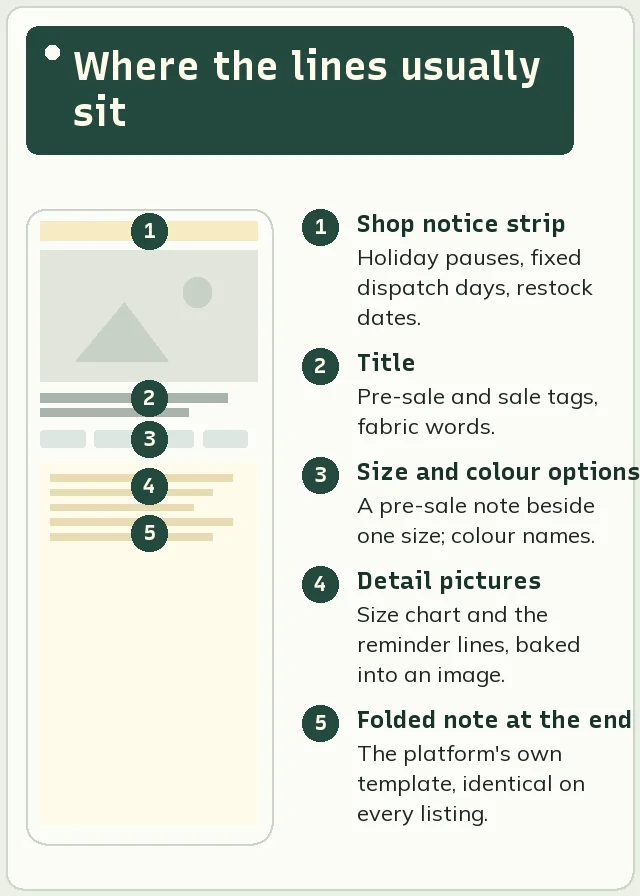
A Chinese listing is crowded: a shop notice strip at the top, photos, a title stuffed with search words, size and colour choices, then a long run of detail pictures. When a seller does print advance warnings, they usually hide in three of those places. Short ones sit in the title or next to a size option, such as a pre-sale tag. Longer ones are usually baked into a detail picture near the end, under a heading like 温馨提示 (a friendly reminder). Dispatch pauses go in the shop notice.
On 19 October 2026 we opened fifteen public Weidian listings for plain clothing and accessories in a phone-sized browser (our own check). None of the twelve phrases on this page appeared in the listings' text, and the closing detail pictures we looked at were product shots. The only shop-level promise we saw was a 72-hour dispatch badge in the header, on eight of the fifteen. All fifteen ended with the same folded block titled 购前说明 (notes before you buy), and that block is the platform's own text, not the seller's: it says the shop is responsible for its title, price and details and asks buyers to confirm anything unclear, such as pre-sale status, before paying.
So the first habit is simple: before reading a warning, work out whose words they are. Keep the seller’s statement with the order as evidence of the advertised terms. A platform line is the same on every listing and tells you nothing about this piece.
Warning sorter: what is already said, what is still open
Tick every line you can see, either on the listing (title, size options, detail pictures) or in the shop notice above it, then pick the kind of item. The left list repeats the seller’s stated position. The right list keeps the questions to check for that item type, even when a warning mentions them; each one carries a note on whether the warehouse photos at the featured agents usually show it, going by the scope each agent published (re-read 18 October 2026).
Seller’s stated warnings
Details to verify before accepting the item
The seller states a return restriction. Clarify eligibility before paying; a label does not decide every defect, mismatch or refund claim.
The sorter does not read links, prices or sizes, does not score a seller and does not tell you whether to buy. Its caution appears when a sale or made-to-order line meets a no seven-day return label, because that combination needs a clear answer about the actual order terms before payment.
How to use the tool on a real listing
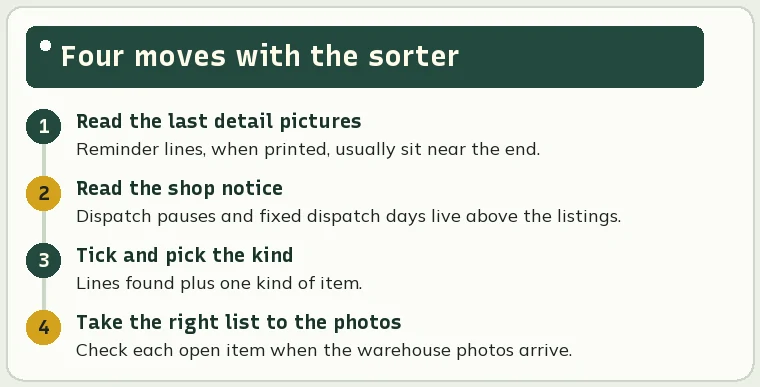
Open the listing on your phone or computer, not the catalogue card. Scroll the detail pictures to the end; when a shop prints reminder lines, they usually sit near the end. Then open the shop's main page and read the notice strip. Tick what you found, even if you only recognise part of a phrase: the help desk's glossary lists each one with its usual variants.
- Tick the listing lines you found, then any shop notice lines.
- Pick the kind of item; the right list changes with it.
- Read the right list as your checklist for the warehouse photos.
- If the red line appears at the bottom, settle size and colour with the seller before paying.
The right list is deliberately blunt. It does not say that a problem will happen or that a claim will succeed. Keep the checklist and the seller’s warning together when asking for an explanation. Where the tag says the photos usually miss it, ask for a specific photo or accept the risk.
Colour judged against the real piece, as the shop puts it
色差以实物为准 is one of the lines seen most often on clothing listings. It reads roughly as: if the colour differs, the real piece is what counts. In practice the seller is saying that differences caused by studio lighting, phone screens and photo editing are not a fault. A darker shade of the same green, a cream that looks whiter on screen: that is what the line covers.
It does not cover a wrong colour variant. Order black and receive navy, and the seller sent the wrong item; the line does not help them. That distinction matches how agents treat colour too. LoongBuy's help centre puts it in one sentence:
A lighting-related color difference is not treated as a confirmed product color defect.
No featured agent judges a shade for you, so the question rests with you: compare the warehouse photo with the listing photo, remember both were taken under different lights, and judge the colour family rather than the exact shade.
A tape-measure margin written into the listing
Size charts on Chinese listings are measured by hand with the garment laid flat, and many say so: 手工测量,存在1-3cm误差, hand-measured, an error of one to three centimetres. Some write 1-2 cm, some 2-3 cm. The line means the seller will not treat a measurement inside that margin as a wrong size.
Three centimetres sounds small until you set it against the chart: it is often close to the gap between two neighbouring sizes. Read the chart in centimetres, ignore the letter, then lay a top you already like flat and measure it the same way. A letter size is a label, not a promise.
A standard warehouse check will not catch a margin problem either, since none of the featured agents measures pieces as a matter of course. If the fit is tight on paper, a measurement photo is the only way to know before shipping, and that is a paid extra at most agents.
The trait a seller names before the caution
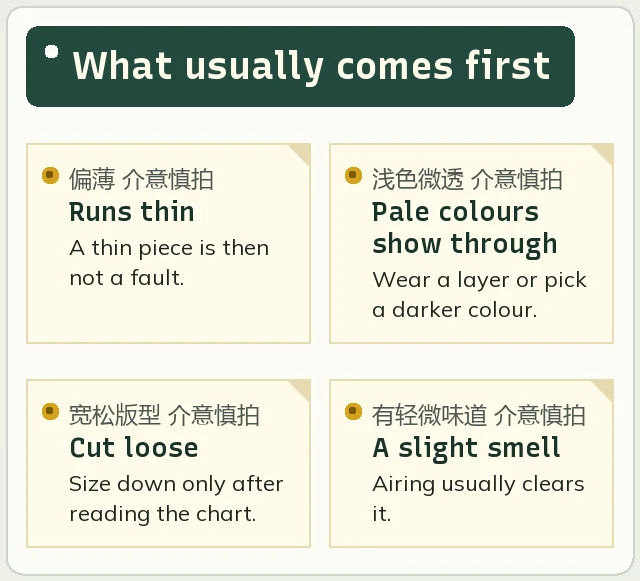
介意慎拍 means, roughly, if this bothers you, think carefully before buying. The phrase on its own says nothing. The half-sentence in front of it is the warning: 偏薄 (runs thin), 浅色微透 (pale colours show through slightly), 宽松版型 (cut loose), 有轻微味道 (a slight smell). The seller is naming a known trait and asking anyone who minds it to stay away.
Once named, the trait is part of the item. A stated thin fabric may be intentional, but compare the actual description and item before deciding whether there is a mismatch. The useful move is to read the front half carefully, ask the agent's buyer to translate it if the wording is unclear, and decide before you pay.
Thread ends, creases and the smell of a new garment
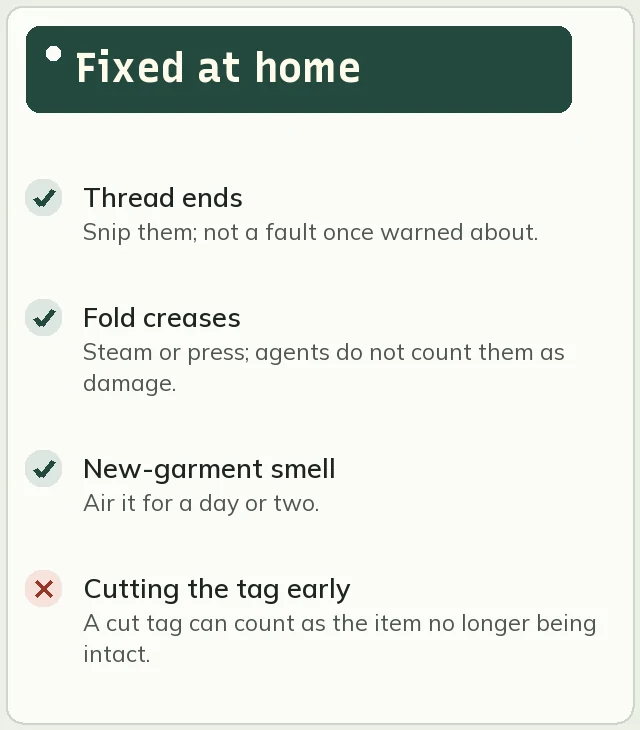
Three lines often turn up together on cheap and mid-priced clothing: 线头不属于质量问题 (loose threads are not a quality fault), 折叠运输会有褶皱 (folding in transit leaves creases) and 新衣有气味,通风即可 (a new garment may smell; air it). They pre-empt three complaints that come up a lot and that sellers would rather not argue about.
A loose thread, a fold mark and an unexplained odor need different judgments. Do not trim, wash, steam or otherwise alter an item while you are deciding whether to raise a claim. Photograph the condition and ask about it first; a persistent odor, structural seam problem or permanent damage should not be dismissed because a general warning exists.
One caution from the national rules on seven-day returns: for clothing, a removed or cut tag counts as the item no longer being intact. Snip threads, not tags, until you are sure you are keeping the piece.
Pre-sale windows counted from the day you pay
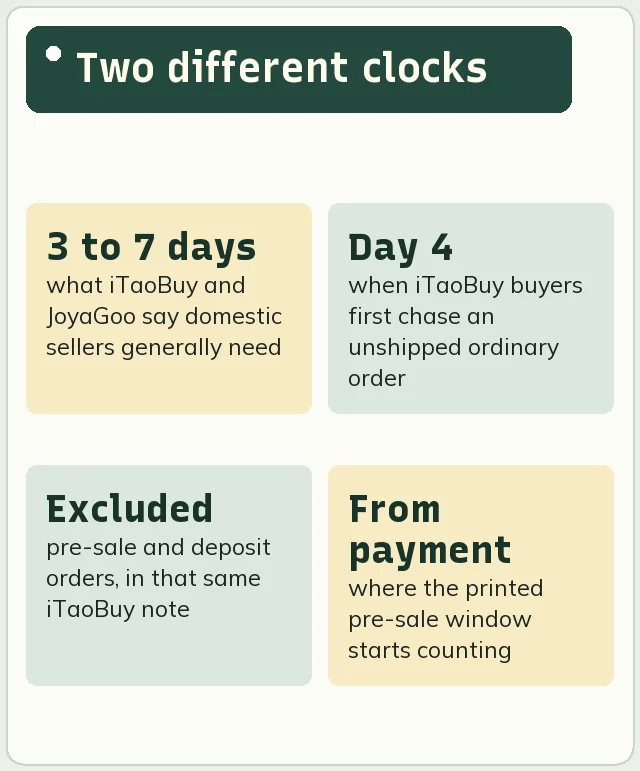
预售 means the piece is not in stock yet. The listing gives a window, usually written as 付款后15天内发货 or similar: ships within so many days of payment. The clock starts when the agent's buyer pays, not when you top up your balance, and nothing reaches the warehouse until the seller ships.
Agents handle these orders differently from ordinary ones. iTaoBuy's shopping notes say domestic sellers generally ship within three to seven days and that its buyers follow up from day four, then add: excluding pre-sale and deposit orders. JoyaGoo's Chinese help page says the same about Taobao sellers and excludes made-to-order and pre-sale goods. In plain terms, a pre-sale order is allowed to sit, and the follow-up routine waits for the date the seller printed.
Two practical points: put pre-sale pieces in their own order so they do not hold back a parcel, and note the date the window ends. If it passes, that is when to ask the agent to chase or cancel.
Ask-first listings and the agent's buyer as go-between
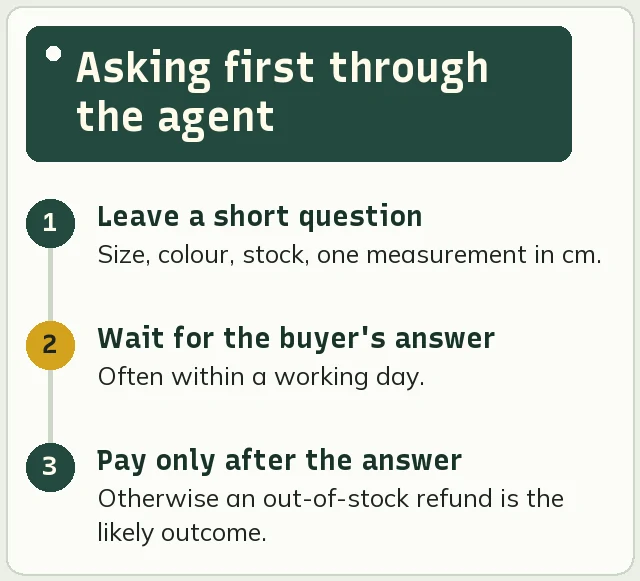
拍前咨询 asks you to message the shop before ordering. Usually it means stock is uncertain, a colour has run out in some sizes, or the seller wants to confirm measurements. Paying without asking often ends in an out-of-stock refund a few days later, with the parcel plan delayed.
The agent’s buyer can contact the seller for the purchase. Direct marketplace messaging may also be possible if you have access, but keep any relevant answer in the agent’s order record. Most agents let you leave a note on the order or ask customer service to contact the seller first. Keep the question short and specific: is size L in stock in grey, and what is its chest width in centimetres. iTaoBuy states that an out-of-stock order is cancelled automatically if you do not reply within 72 hours, so watch for the agent's message.
A no-return label and what the rules ask of the seller
Some listings carry 不支持七天无理由退货: no seven-day no-reason return. The label matters because China's rules on online returns allow a seller to exclude only certain goods, and to exclude some of them only with the buyer's confirmation. The 2017 measures on seven-day returns, as amended in 2020, name four kinds that are excluded outright (goods made to the consumer's order, fresh perishables, opened or downloaded digital goods, delivered newspapers and periodicals) and three kinds a buyer can agree to exclude, among them goods sold with a defect disclosed at the time of sale.
The 2024 implementing regulations of the consumer law, in force since 1 July 2024, add that a seller must mark excluded goods prominently, ask the buyer to confirm, and may not make the exclusion a default option. Both texts are on the government portal: Seven-day no-reason return measures (2017, amended 2020) and Consumer Rights Protection Law implementing regulations (2024) (both read 18 October 2026).
What this means for an order placed through an agent is not something we can settle. The rules are written for consumers buying on Chinese platforms; through an agent, the agent's account is the buyer, and in practice the seller's answer to the agent decides whether a return happens. Treat the label as the seller's position, and plan as if it will be applied.
The full set of lines, side by side
Here are all twelve, in the order the sorter lists them. The Chinese is given as it is usually written; shops vary the wording, add punctuation or swap a word, but the core characters stay the same. The last column describes what the seller is attempting to address, which is exactly what the sorter moves into its left list.
| Line | Usual Chinese | Seller’s stated position |
|---|---|---|
| Colour | 色差以实物为准 | shade differences from lighting and screens |
| Hand-measured margin | 手工测量 存在1-3cm误差 | measurements inside the margin |
| Named trait | 介意慎拍 | the trait named just before it |
| Threads and small flaws | 线头不属于质量问题 | loose thread ends, tiny flaws |
| Creases | 折叠运输会有褶皱 | fold creases |
| Smell | 新衣有气味 通风即可 | a new-garment smell |
| Sale piece | 特价清仓 不退不换 | changing your mind |
| Made to order | 定制现做 不退不换 | changing your mind |
| Pre-sale | 预售 付款后N天内发货 | slow dispatch inside the window |
| Ask first | 拍前咨询 | stock surprises, if you did ask |
| No seven-day return | 不支持七天无理由退货 | no-reason returns |
| Shop notice | 节假日停发 固定发货日 | delays the notice announced |
Translate the warning without surrendering the question
“No change-of-mind return” does not answer whether the seller sent the selected option. “Hand measurement tolerance” does not identify how the tape was placed. “Color may differ” does not prove that two differently named variants are the same. Ask what the wording means for the precise item and retain the reply before deciding.
China’s published online-return measures distinguish exclusions and confirmation requirements; the implementing regulations prohibit expanding exclusions arbitrarily or using default consent. This page translates wording rather than deciding legal entitlement for an agent-mediated purchase. Read the published return measures and the implementing regulations.