
Choosing shops and pieces by the notices they post
A shop's notice strip and a listing's advance lines tell you more about a seller than its rating does, if you know which words are the shop's own.
The shop notice above every listing
A shop may publish a notice strip, 店铺公告, that sits above its listings and on its main page. Sellers use it for what applies to everything they sell: dispatch paused over a holiday, parcels sent only on fixed weekdays, a restock date, a closure week. Check whether that notice applies to the item, ordering date and selected option; save it if it affects the purchase.
Holiday pauses usually cluster around the Spring Festival and the October national holiday, and a pause usually covers dispatch rather than ordering: the shop takes your money and ships when it reopens. Fixed dispatch days are quieter but matter just as much. A shop that ships on Tuesdays and Fridays can hold a Saturday order until Tuesday without breaking any promise it made.
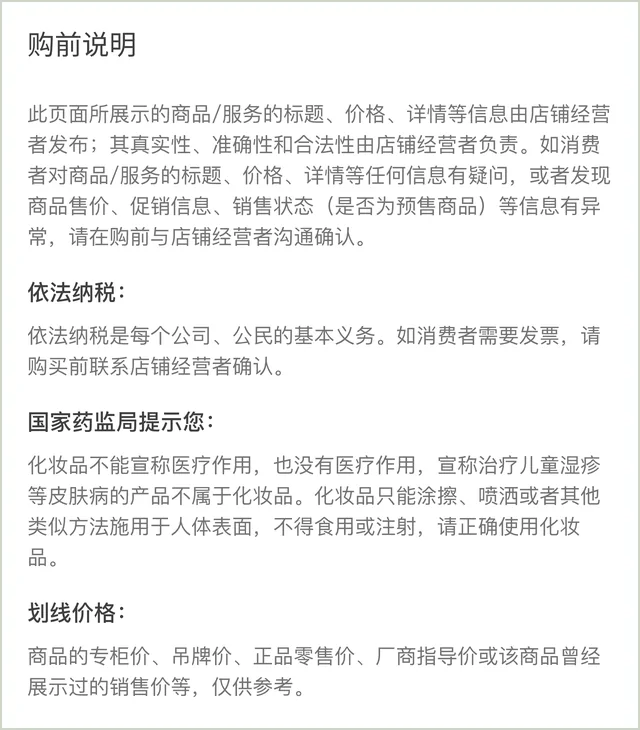
Keep the platform's template apart from the shop's own words. On the Weidian listings we opened on 19 October 2026, the folded note at the end of every listing was the same platform text, and the shop-level promise that did vary was a 72-hour dispatch badge in the header of eight of the fifteen.
Made to your size, and final once it is cut
定制 and 现做 both mean made to order: cut after you pay, sometimes to measurements you send. 定制不退不换 adds the expected line, no returns or exchanges. This is one of the few warnings with a clear basis in the national return rules, which list goods made to the consumer's order among the four kinds excluded from seven-day returns outright.
Agents follow suit. Hipobuy, Oopbuy, iTaoBuy and JoyaGoo all put custom-made items at the top of the list of goods their five-day return arrangement does not cover, and LoongBuy's FAQ says its own five-day refund does not apply to all goods. A custom-order exclusion concerns change-of-mind returns; it should not be used here to decide a claim about the wrong specification or a defect. Ask for the applicable process before ordering.
That makes the order note the place to be careful. Send measurements in centimetres, say which garment you measured, and ask the agent's buyer to repeat the numbers back from the seller's reply before paying.
Choosing a seller from what the listing admits
Ratings and sales counts are the usual way to judge a shop, and they are worth a glance. For a buyer abroad a different signal says more: how much the listing admits in advance. A reliable seller, from where you stand, is one whose page lets you predict what will arrive.
- a size chart in centimetres, with the margin stated
- the fabric named in words, not only in the title keywords
- a trait named before any caution, rather than the bare caution
- a dispatch window in days, in the listing or the shop notice
- photos of the actual piece on a plain background, not only styled shots
A listing that says nothing at all is not more honest than one with twelve lines. It only means every question is still open, and you will be asking them through an agent, in translation, after paying.
Choosing a piece the warnings will not spoil
Deciding what to order is partly deciding which warnings you can live with. A colour line matters little on black and a great deal on a dusty pink or an olive that could go brown or grey. A margin matters little on an oversized hoodie and a lot on trousers you want to fit at the waist.
Pick the pieces where the likely surprises are cheap: forgiving cuts, colours that photograph honestly, fabrics where creases and smell fade. Save the risky combinations, fitted and pale and on sale, for shops whose listings tell you more.
Traps to avoid before you pay
Most of the expensive mistakes happen before payment, and most of them come from reading the catalogue card instead of the listing. Things to watch out for:
- Paying for a size the shop notice says is restocking, without asking first.
- Treating the letter size as the measurement.
- Putting a pre-sale piece in the same order as pieces you want soon.
- Skipping the last detail pictures, where the reminder lines usually are.
- Buying a sale piece and a no seven-day return label together without settling size and colour first.
- Cutting tags at home before you have decided to keep the piece.
None of these needs more than a few minutes. Together they cover most of what goes wrong between a listing and a parcel.